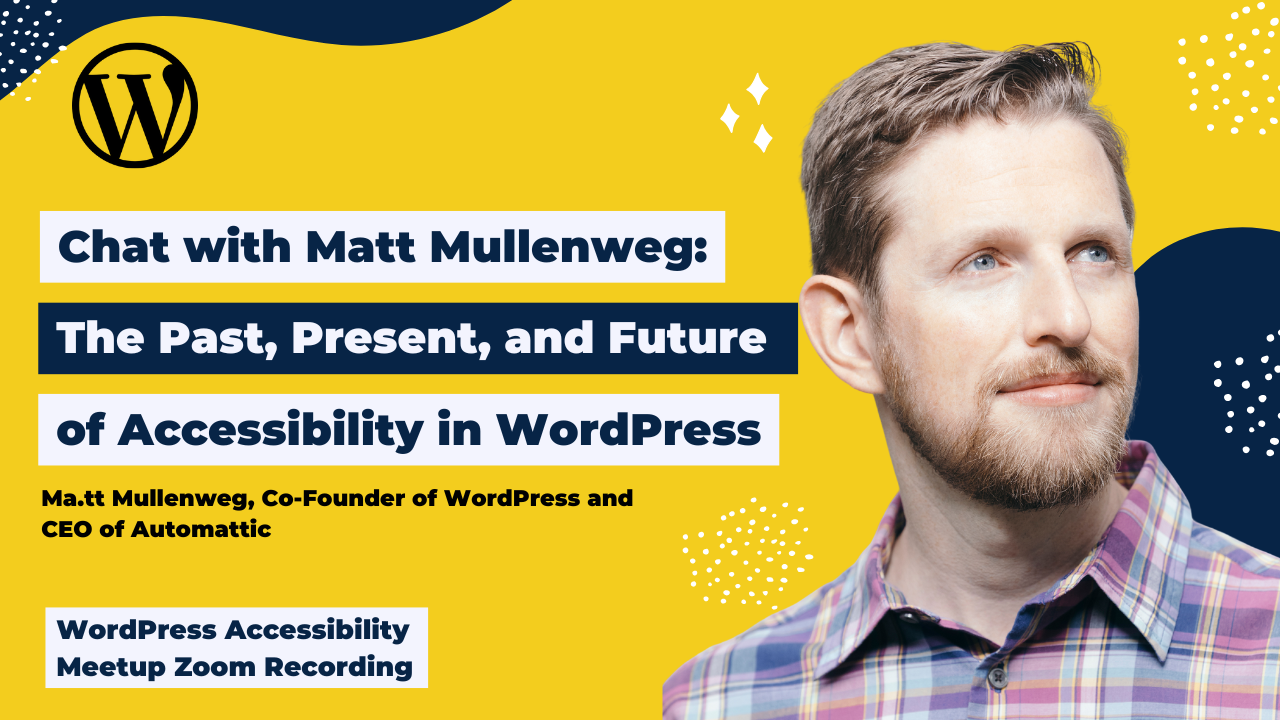
During a recent WordPress Accessibility Meetup, Equalize Digital CEO Amber Hinds sat down with WordPress co-founder Matt Mullenweg for a wide-ranging conversation about the past, present, and future of accessibility in WordPress. They talked about the history of the accessibility team, how laws like the European Accessibility Act and tools like AI are influencing priorities, what’s on the horizon for Gutenberg and the WordPress admin, and how our community can grow the next generation of accessibility contributors.
Thanks to Our Sponsor
Kinsta provides managed hosting services for WordPress. It is powering 120,000 businesses worldwide and based on the user reviews it is the highest-rated managed WordPress host on G2. It has everything you need, including an unbeatable combination of speed, security, and expert support.
Powered by Google Cloud and the fastest C3D and C2 servers combined with CDN and Edge Caching. Your sites are secured with Cloudflare Enterprise, protecting you from DDoS attacks. All plans include free migrations, and the first month of the starter plans is completely free, so you can try the service risk-free.
Watch the Recording
If you missed the meetup or would like a recap, watch the video below or read the transcript. If you have questions about what was covered in this meetup, please tweet us @EqualizeDigital on Twitter or join our Facebook group for WordPress Accessibility. You can find Matt Mullenweg on Twitter @photomatt.
Read the Transcript
[00:00:00] Amber Hinds: Welcome to WordPress Accessibility Meetup, chat with Matt Mullenweg: The Past, Present, and Future of Accessibility in WordPress. Before we get started, there are a few things that you should know, and also these are frequently asked questions. So the best way to connect with other attendees in between meetups is if you go to facebook.com/groups/ wordpress.accessibility.
You can post questions there, share what you’re working on, help other people, and really just connect in between these Zoom sessions. Everyone always asks, is this being recorded? Yes, it is being recorded. It will, it generally takes us about two weeks to get an edited video and corrected captions into transcript.
We are gonna try and get this one out a lot faster though. So you can find upcoming events and past recordings and this one will also be posted if you go to Equalize Digital dot com slash meetup. [00:01:00] That’s the best way to find it. Otherwise, if you join our email list at Equalize Digital dot com slash focus dash state, then we will send an email when the recording is available.
If you prefer to listen in audio format, you can find recordings from meetups on our podcast, Accessibility Craft dot com. A quick note that this is part of the Meetup program, however, the community team told us that they don’t have any funds to cover the cost of making it accessible, and so they said go out and find sponsors.
We are nearing the end of 2025 and some of our amazing sponsors who have been helping to cover the cost of live captions and transcriptions and other things for the meetup. And so we are seeking additional sponsors for the Meetup for 2026. So if your company would be interested in helping to make WordPress Accessibility Meetup accessible, please get in touch.
You can contact myself and [00:02:00] my co-organizer, Paola, if you email meetup at Equalize Digital dot com. That is also the email address. If you need any accessibility assistance or if you have any suggestions or if there is something that you want to learn about next year, please email us and let us know.
So who am I? I am Amber Hinds. I’m the CEO of a company called Equalize Digital. We are a mission-driven organization and a corporate member of the International Association of Accessibility Professionals, or the IAAP, and we are focused on WordPress accessibility. We have a WordPress plugin that is free on WordPress dot org called Accessibility Checker that helps you find and fix accessibility problems on your website.
We also offer online courses in NVDA and Voiceover screen reader testing. We do accessibility audits, remediation and consulting, and we run this meetup, which is one of the fun ways that we help to give back. We have a sponsor that I want to [00:03:00] thank today, and that is Kinsta. Kinsta is very generously covering the cost of live captions for this meetup, and they have been doing it for about the past year.
So a huge shout out and thank you to them. Kinsta provides manage hosting services for WordPress. It is powering 120,000 businesses worldwide based on user reviews. It is one of the highest rated managed WordPress hosts on G two. It has everything that you need, including an unbeatable combination of speed, security, and expert supports.
You can learn more about Kinsta if you go to Kinsta.com. We always ask that everyone, please if you are willing, send them a quick shout out on whatever your preferred social media platform is and say thank you for sponsoring captions for WordPress Accessibility Meetup. It tells them that sponsorship matters and makes a difference, and it helps to encourage them to want to continue sponsoring.
[00:04:00] Two upcoming events that I want to note: in December, we’ll be back on our normal first Thursday of the month, on Thursday, December 4th at 10:00 AM Central Time. And Brian Coords, who is a developer advocate for WooCommerce, will be coming on with me and doing some live accessibility remediation. So if you have ever wanted to know how to fix a problem on a WordPress website, that would be a great one to tune in for because you’ll see real problems and how he approaches fixing them.
And then note that in January. The first Thursday in January is the first day of January, and I’m sure most of us do not want to come to a meetup on that day. So the January meetup will be on the eighth, which is the second Thursday, and we are going to be putting out a call for speakers for all of 2026 very soon.
So please watch for that. And now I’m going to stop sharing my screen
and [00:05:00] I am going to pull up our wonderful guest, Matt.
[00:05:07] Matt Mullenweg: Ta-da.
[00:05:11] Amber Hinds: Awesome, welcome. I’m so excited to have you here and I feel like you don’t need an introduction, but at the same time, I’m always interested to hear what is the thing that you’re most excited about what you’re doing right now that would introduce people to who you are?
[00:05:26] Matt Mullenweg: Oh, that’s very interesting question.
Yeah, I do a lot. So I,
[00:05:30] Amber Hinds: I didn’t prep you for that one. I’m sorry.
[00:05:32] Matt Mullenweg: No. It’s and that’s part of what I love is I love being able to move between different projects. It gives me a lot of inspiration, like cross things and, so Automattic. We obviously have WordPress dot com, WooCommerce, Tumblr, Jetpack in our ecosystem side.
And then we have what we call coscos businesses. Like day one app apps you should check out PocketCasts for podcasting, Day One for journaling. Beeper Now for multi messaging is the newest area with that win. Tumblr, if you want some cool social blogging and to be hip again, like a teenager. So [00:06:00] that’s pretty fun.
Then WordPress dot org obviously is 22 years now and hopefully the rest of my life. And that’s incredibly engaging just for the people. The, just, it’s wild that it’s almost impossible idea, like that people all over the world would come together to create this open source, CMS and it’s truly, it’s nothing without the people, and it’s very volunteer driven. Automattic obviously is a big supporter in many other companies. I thank you, Kinsta, for sponsoring this, by the way. But yeah, there’s there’s, tens of thousands, hundreds of thousands as you add up, like kind of plugins and everything like that of people in the ecosystem that that contribute to it.
That’s why I like calling it ecosystem because it is like a very complex being. It’s like a rainforest, and I make angel investments through Audrey Capital. I have over a hundred big companies like Stripe and SpaceX. Lots of small things, fun ideas that I just wanna see exist in the world and like in any angel investment, lots of failures, but some pretty good outcomes so far and some more to come.
It’s it’s a way I got a lot of support when I was a young entrepreneur, 20-year-old kid, moved to Houston, and so it’s my kinda way to pay it for it. I wrote don’t do it for return, I just do it for yeah, to support. To support entrepreneurs. I got [00:07:00] that leg up and people took a chance on me way back in the day when there was no good reason to.
So then finally last project, and this is probably my last one for a while, is this jazz club and in San Francisco called Keys Jazz Bistro that I co-founded with this great guy, Simon Rowe, who runs it day to day. So that’s a nice one. I could just show up, but it’s it’s a beautiful jazz company.
If you’re ever in San Francisco, please check it out.
[00:07:21] Amber Hinds: That is really neat. I don’t think I ever knew that about you, that you also had a non-tech business.
[00:07:27] Matt Mullenweg: It’s not, it’s a business. Yeah. It’s a fun thing for me. It know every release of WordPress is named after jazz musician, and there’s a reason for that.
It’s it’s how I got started with websites, was building websites for jazz musicians and, and then that turned into, hacking on open source software. I put forums on them, like P-H-P-B-B, and V Bulletin. Then I started thinking about galleries and music players just found open source and fell in love.
It’s oh, this is the thing. Obviously I’m gonna do the rest of my life.
[00:07:51] Amber Hinds: Yeah, that’s really cool. So I very much appreciate you coming here and being willing to chat about accessibility with us. As you can see, we’ve got [00:08:00] lots of people from around the world who are really interested. For everyone.
We will have some time for q and a related to accessibility questions. So if you wanna put those throughout the conversation in the Q and A module in Zoom, that’s much easier for us to keep track of than the chat. I’m probably not gonna pay attention to the chat. It’s very hard for me to watch and talk at the same time.
[00:08:20] Matt Mullenweg: Yeah.
[00:08:20] Amber Hinds: So put those in and I will pass those along to Matt towards the end of the webinar. I’d be curious, just to start like with the history of obviously you were talking about WordPress has been around for 20 plus years. It’s very community driven. Can you share any history that you have on the accessibility team, how it got started and maybe how the approach to accessibility in WordPress has evolved over the past 20 years?
[00:08:46] Matt Mullenweg: Yeah. It’s an interesting question. I actually had to look it up ’cause I forgot, but it was 2014, I believe the team’s 20.
[00:08:53] Amber Hinds: Okay.
[00:08:54] Matt Mullenweg: Maybe 2013. But the handbook was first published in 2014. And, but like you said, accessibility [00:09:00] has been really part of WordPress from the very start. And, one of the big differentiators for us was the sort of attention to web standards and the the importance of like compliant code.
That was actually why I started hacking on things like like phpBB and. What was the one that I turned into? BB Press, I forget. But it I just wanted the code to be compliant. I was like, all this, all of the HTML is terrible in the world. You, I was obsessed with the W three techs or W three C.
[00:09:26] Amber Hinds: W three C. Yeah.
[00:09:27] Matt Mullenweg: I haven’t visited that in a while. I’m curious actually. I stuff, but I was obsessed with it. I just ran every website, I visited through it. I ran every project. And then and that was a lot of my early contributions to things, including B2, was making the code more standards compliant and and beautiful as well.
My first contribution was actually a typography plugin. It’s still in WordPress. It’s called texturize. So good. It makes your post grow is the tagline. It’s it’s add typo, typo typographic entities using regular expressions actually to plain text. So it figures that out.
Very tricky. And, but it was fun [00:10:00] coding. It was like my kind of entree to to coding was that contribution. So that’s how, so it got started. I don’t recall exactly but I know the time and but I will say that it’s always been, part of our DNA and, I know we have some questions about this later.
I think it’s something that a lot of core developers including, Matias, Riad, Rich Tabor, like all the people who’re in Gutenberg and core are leading. I’ve always cared about accessibility. Yeah.
[00:10:26] Amber Hinds: Do you see ways that accessibility can or has maybe driven some innovation in the WordPress space or within Gutenberg?
[00:10:37] Matt Mullenweg: That’s a good question. I think one interesting thing is that the, I’m very excited. Actually, the craziest thing I’ve seen since ChatGPT is this sort of agentic browser comment. I talked about it at at WordCamp US, and have you tried it yet?
[00:10:52] Amber Hinds: No, I haven’t.
[00:10:53] Matt Mullenweg: Oh, you have to.
It’s wild. But it basically, it’s a robot that’s figuring out, how to use WordPress. And [00:11:00] it’s fascinating to watch it stumble. Sometimes it gets lost, often with a usability issue that I think we have. But it does use accessibility labels, so the bot actually reads its accessibility labels.
And so it’s a, I love the story in accessibility you design for accessibility, not just for people who need it, but for people who might be temporary disabled or maybe it’s like someone holding a kid and so they need to open the door with one hand. So that sort of thing is is kind a, an unexpected side effect of this investment. And and yeah, so that’s one it’s accessible for these bots too, which I think is gonna be very key to the future.
[00:11:34] Amber Hinds: Yeah, I mean I, there’s been so much conversation about the change in search and how search is changing with the introduction of the AI chat and it’s so interesting be when going back to what you were saying about HTML being valid and at the core, that’s really a lot of what accessibility is having valid clean code, which is better for performance, it’s better for search and probably, [00:12:00] yeah, it’s way better for all the chat bots and all those things that are trying to learn about your website.
[00:12:05] Matt Mullenweg: Yeah, it’s actually, I highly recommend everyone use this just for usability testing. It’s amazing because like user research is valuable but hard often. So it’s you have this kind of dumb person, who’s gonna, who’s gonna struggle just like a human will to to try things. And before the AIs get too smart, you should use it for usability testing.
[00:12:24] Amber Hinds: That’s a fun idea. Did you, this is like a total tangent, but did you ever see, there was a guy, I don’t know, it was maybe like seven or eight years ago and he was getting paid by very large companies. Like I think I saw the one for HubSpot and he would do YouTube videos called The User Is Drunk.
[00:12:41] Matt Mullenweg: Wow.
[00:12:42] Amber Hinds: And he would get drunk and he would try to use companies, and companies thought it was funny. So they would pay him. But he would give user,
[00:12:48] Matt Mullenweg: Is still going? We should hire him.
[00:12:50] Amber Hinds: I don’t think he’s done that for a very long time. But maybe we could. I’m sure you could find somebody to do that for you.
But it, it is interesting to think about all these different [00:13:00] scenarios of people using your website that you might. Like not, it’s never just a best case scenario, right? Yeah. There’s all these different environments, different situations that people might be in or different abilities that people might have.
[00:13:12] Matt Mullenweg: It’s actually one of my engineering principles as well, I think great code designs for the failure case first and to fail gracefully. And thinking about those edge cases, they’re not actually edge cases and if you can architect your code in a way that it it never assumes the network is available and, it just assumes slow networks or assumes that, you’re not gonna be able to reach the HTTP request or something like that.
It’s far more robust and and better code. So I like it.
[00:13:36] Amber Hinds: So talking about quality code, we, you and I had a conversation at WordCamp Europe in Italy, so a long time ago about plugin linting and the plugin check plugin, and I know what could we potentially do on the accessibility front there?
And now fast forward to just like last, at the end of last month, the [00:14:00] plugin team said that they are now doing automated plugin checks on updates on everything that’s on WordPress dot org, which I think is amazing. I know WooCommerce does this already. And actually it will reject, if you fail certain things, it will reject and it will say, Hey, no, you can’t put this update in the plugin extension directory and send it out to people unless you first fix the problems.
So I’m curious, I have a few questions about this. My first one is for WordPress dot org. Do you see that potentially, are we on a path towards rejecting updates or plugins on WordPress dot org that are going to have major, like security issues or other things?
[00:14:45] Matt Mullenweg: Oh, first, I’ll say this is, I think, one of the most exciting things in the WordPress world right now.
It’s really wild to see and very, it could upgrade everything. Yes, I think security it’s, I won’t call it a rejection, I’ll just call it a feedback loop, and hopefully these are things developers can run locally [00:15:00] as like a compliment to the linting process or testing process or other things.
Yeah, it’s yeah it’s, I think, gonna be great. Now, security’s tough. So there’s, I think the usefulness of an automated check is gonna be pretty basic for now. I’m sure it’ll get better with AI and everything, but right now it’s, I think we even do some you didn’t escape this HTML and stuff like that, but it’s pretty basic.
It’s important, but still basic. Yeah.
[00:15:22] Amber Hinds: Yeah. Do you think there would ever be public badges on plugins? So on our GitHub repo, we have these that shows things like, it’s passing WPCS, it’s passing. Other coding standards like we have, like what our test coverage is, percentage ’cause we use Coveralls.
Do you ever see things like this showing up on plugins on WordPress org?
[00:15:46] Matt Mullenweg: Yeah. And that’s I did we talk about this already? Because you asked the perfect question. And so I think the future is because I wanna have an open marketplace and I don’t wanna be too like nanny state or policing about it, but I do want customers to be able to make informed decisions, [00:16:00] so badges for… anything, translation security checks, code quality, accessibility someday. If you, y’all can make some tests, I think that’s a better way to do it. Versus rejecting or something. Just let people search and filter by, this is, whatever the team comes up with is like different levels or things you can automate.
I know it’s very hard to automate that stuff. That’s part of why your company exists, but some basic things, right? Yeah.
[00:16:23] Amber Hinds: Yeah. No, I, so I mean that literally led me into my next question ’cause I’m like trying to figure out where does this all fit in and can accessibility be part of that?
Which as you mentioned, it’s really hard and in particularly I think with PHP to do a lot of automated checks for accessibility unless you’re rendering, right? Like you have to basically render the page. But I do feel like maybe there are some things and it would be nice for website users to be able to be alerted to, Hey, this problem might exist, or this plugin doesn’t have [00:17:00] any known issues.
You still need to test it, but-
[00:17:03] Matt Mullenweg: And badges could be manual as well. I think we’ll do, start doing some things around like plugin picks and other things. So there could be a manual accessibility batch that your team drives and, maybe.
[00:17:12] Amber Hinds: Like the one for themes? Like the accessibility
ready for themes, you mean?
[00:17:17] Matt Mullenweg: Yeah, kinda like that and say do one a week or something and let people submit. Pick your favorite plugins, the canonical ones, probably the open source ones. And and do make that a team cadence or something. It could be fun. I’m just brainstorming, but yeah.
[00:17:29] Amber Hinds: Yeah, so yeah, I, it’s so interesting.
I, it’s hard though ’cause I think. So I’ve been working with some other people on the accessibility team to rework and update and modernize the accessibility ready guidelines for themes. And then I built out this whole really detailed process to help anyone know how to test a theme. ’cause one of the problems we’ve run into with the manual text is that it’s time intensive.
And if there’s only a small number of people on the accessibility [00:18:00] team, it’s who’s gonna do that and when? And so I’m like we gotta make it easy for somebody who’s not an expert to come in and say, I look at these things and I can pass or fail it. So that, that’s a challenge. And I don’t know if you have any thoughts about that, with what you’re saying.
’cause I love the idea of manual, like this has been reviewed by an expert. But at the same time I’m also realistic about, who would do that? And as we do a lot of auditing for plugin companies, I. Yeah, I’m sure you know that because we do it for WooCommerce and we do it for other companies as well.
And there’s weird things you have to think about where you you have to set up a block like eight times because you have to have every possible setting, variation things, so it’s not like it’s fast. I don’t know.
[00:18:45] Matt Mullenweg: I think the key there is actually just an education issue. I think y’all should be part of training the next generations of future contributors.
We’ve had this problem with kind of every part of WordPress for a while. We didn’t have enough developers, we didn’t have enough designers, and we didn’t have enough, whatever. And it’s really just that kind of [00:19:00] barn raising, the recruiting and the training of the next generation I think is really important.
[00:19:05] Amber Hinds: So I had a couple of questions about this.
[00:19:07] Matt Mullenweg: Are you training the next Amber, is there like a, do you have a pipeline there?
[00:19:12] Amber Hinds: Okay, so I have some ideas about this and I wanna float a couple by you and see what you think. Sure. So one is inspired by one of the things that I love that you guys do at Automattic, which is you make everyone
do customer service some amount of the year, right?
[00:19:27] Matt Mullenweg: Yeah, one week a year. I actually did one yesterday. I do it every week actually. Just I do, but I don’t do the answering tickets as much. I do ride-alongs with, ’cause I try to go through every single product in the company. We’ve got it’s a ride along product, so a ride along.
It’s a, it’s like a cop term actually. You did like a ride along with the police. So basically I pair with one of our amazing happiness engineers and it’s screen share. And so I’m watching them work and it’s actually been very fascinating. So it’s ’cause I’m learning a lot about workflows, about internal tools, about how people are using AI, which is pretty amazing.
Our happiness engineers are the secret. Secret [00:20:00] power of Automattic. And so they’re very talented. So it’s been great to, and also I’m trying to meet everyone in the company as I have personal goal which is tough ’cause we’re 1,470 people, but we have a tool that tracks that.
It’s called Meetamatician. And so I know,
[00:20:12] Amber Hinds: So you can keep track of who you’ve met and not?
[00:20:14] Matt Mullenweg: I’m gonna see my percentage, actually, if you don’t mind me looking it up I’m curious what it is. I think it’s been high in the past, but it came down post COVID and stuff and we haven’t done a good is it Mad Space?
So I haven’t, we haven’t done a meet the meetup in a while. Meet-a-mattician. Yes. So we’re right now 1,466 and, let’s see, it’s loaded. I’ve met 35%, so 511 of them, which is pretty good. But like-
[00:20:37] Amber Hinds: You got a lot of people to meet.
[00:20:38] Matt Mullenweg: 35%. Yeah. That’s not okay. That’s not, that’s fa failing for me, so I gotta do some work there.
[00:20:43] Amber Hinds: Yeah. So this is the one of the ideas I had. Can we make – “make” – I don’t know how this works when people are volunteers, but strongly encourage like the same concept of you don’t, you’re, you have this [00:21:00] disconnect if you don’t talk to customers at least once a year. Can we strongly encourage or require in some way that all contributors to WordPress should spend at least a week on the accessibility team every year?
Because there is so much, like the thing that’s interesting about this to me is. All of us started not knowing anything about accessibility.
[00:21:22] Matt Mullenweg: Yeah.
[00:21:22] Amber Hinds: And when I think back on some of the websites that I built, honestly, actually I did a webinar for Green Geeks and I was like, I need a demo on a website.
I have this old copy of our agency website, but from before, and I demoed with it so you people could go find this on the Green Geeks YouTube channel.
[00:21:39] Matt Mullenweg: Wow.
[00:21:39] Amber Hinds: It’s so bad. But we all start somewhere. But it’s one of those things that once you get in and you start learning and you start understanding the why, it’s hard to not see it.
Like I look at websites and color contrast for me, I’m just like, eh, I don’t even need to use a testing tool. I can pretty much tell.
[00:21:54] Matt Mullenweg: Wow.
[00:21:54] Amber Hinds: And I’m wondering if we had some sort of similar path, which is you [00:22:00] wanna contribute to WordPress? Great. Go to the accessibility team for a week or two weeks every year.
That could solve two things, which is maybe more than two things. Like it could get.
[00:22:11] Matt Mullenweg: Awareness,
[00:22:12] Amber Hinds: multiple people on the team, like more bodies to help churn through issues faster. It could also give that learning experience that then they could take back to whatever team they normally contribute to and be like, oh wait, but when I was on accessibility, they were talking about this, maybe we should think about this and our work.
So what are your thoughts on that?
[00:22:33] Matt Mullenweg: I think it’s a cool idea. I’m not into required things, as you can tell. But I think, you catch more flies with honey than vinegar and make it an awesome training. Make it so amazing that like people can’t ignore you, and they’ll just be like, Hey, I really wanna do this.
So I think that’s the key to it. So how do you make it fun? Bring pizza. It’s just all like community building tips, which it’s a lot of, I think it’s also just a lot of manual outreach and you’re an amazing ambassador for the [00:23:00] accessibility movement and also the team.
Think about the outreach there. So it’d be like, Hey we’re putting together this great training. Would you be interested in it? And save people. It’s a lot of time commitment, but it’s yeah, I think that would be, it could be very valuable, very interesting to a lot of folks.
I might take it. Yeah.
[00:23:15] Amber Hinds: You mean something on learn? Is that what you’re thinking when you say a training or you mean more like a live you tune in, like we do at Meetup?
[00:23:23] Matt Mullenweg: Up to you or do it at WordCamp, yeah, but I would say try all the above. Yeah. I think what’s right there, but just try different things.
See what sticks.
[00:23:31] Amber Hinds: This is probably a continual issue that I think a lot of teams have, which is how do you keep people connected after contributor day?
[00:23:41] Matt Mullenweg: Oh yeah.
[00:23:41] Amber Hinds: And I don’t know if you have any thoughts on that, but that’s is one of those, right? People come, they get interested, they do something, but then it’s like getting them outside of the WordCamp to come back.
[00:23:53] Matt Mullenweg: Yeah. Actually one of my ideas there that I think we’ll do, maybe not this year, but maybe we might have it at first Day of the world, but we’ll see [00:24:00] is to make the badges contributor badges show activity. ’cause right now you did one contribution you gotta badge, I want it to be more
[00:24:08] Amber Hinds: 10 years ago,
[00:24:09] Matt Mullenweg: GitHub or something.
It like shows some activity that a core contributor could be mean, a lot of different things and so plug an author. And so so just, I think it’s also just, I wanna make profiles more interesting because there’s so much richness there. There’s so much we could do.
[00:24:22] Amber Hinds: Yeah, I like that idea. The other idea that I had about this, how can we get more accessibility contributors or more train more people that want to learn accessibility or learn WordPress because maybe they know accessibility was, I was thinking a lot about this Campus Connect program that has been started.
And one of the difficulties that I have seen firsthand. So I, when I lived in Colorado, I used to guest lecture for an undergraduate web development course. And once a semester I would teach one [00:25:00] one hour long block about WordPress. The professor just had me come in and do that as part of his course.
[00:25:05] Matt Mullenweg: Awesome.
[00:25:06] Amber Hinds: It was really fun. You can find these old lectures on their, the college’s YouTube channel ’cause they made them all public. But, but one of the things I always observed, and I’ve seen this a lot with bootcamps too, is that accessibility is frequently not mentioned at all.
And so I feel like there’s a need there. And so I don’t know if this has been discussed at all with
[00:25:29] Matt Mullenweg: Do you think it’s demand or what’s the sort of reason for that? If you have to zoom out.
[00:25:35] Amber Hinds: So for bootcamps, I think the reason for that is a lot of times bootcamps skim over HTML Uhhuh, I think they assume HTML is easy. Everybody can you’ll or you’ll just learn it along the way while we teach you the really complex JavaScript things you need to know to do your job and they don’t really deep dive into it.
I don’t know. It’s [00:26:00] possible that this is going to change with some of the laws and the emphasis on, accessibility in particular in Europe, that maybe there will be more demand. And so boot camps will say, okay, we need to be teaching this. But I feel like there hasn’t been the demand in maybe job descriptions and so they haven’t been doing it.
I don’t know the answer for all of the higher ed. That particular course was interesting because the faculty member, the, he was an academic professional who was teaching it. He didn’t really work in the industry. So he knew the academic side of code, but I don’t know if he actually had lived experience with, “I build websites for customers.”
[00:26:43] Matt Mullenweg: Yeah. The Europe thing could definitely help because that’ll create market demand, right? And these market forces will be very powerful. So if you’re a developer and you have accessibility, whatever, certified your training, and you’re gonna be more valuable in those markets, I’m more likely to hire in those countries if you have one of those, so [00:27:00] that, that’ll create a virtuous loop and and get people opting into it.
It’s the same reason why people love learning WordPress. ’cause you can, have a job for life and you can just yeah, it’s a very lucrative skill to have. And so that’s part of what is our key success. So I think accessibility, hopefully could have the same flywheel, but something’s gotta build it up.
It’s harder to- yeah, I actually have some ideas. I think we’ll cover it in later questions, but I think you had a question around what could the accessibility team do? And I brainstormed it a lot, so I have one idea. I think it’s, I think it’s a good one, but you’ll have to tell us.
[00:27:29] Amber Hinds: Yeah. We’ll get there in just a second. I so I’m curious about Campus Connect. Just more broadly. Could any of those students be, could it be made part of their curriculum to participate in the accessibility team? Because that then maybe fills a gap in their education if they’re not getting a lot of that and it helps support the team.
And then the other question I have is just on rolling it out to other other schools and what the process looks like for that. Because we [00:28:00] have a really good relationship with Texas School for the Blind and Visually Impaired, which is in Austin.
[00:28:05] Matt Mullenweg: Wow. Okay.
[00:28:05] Amber Hinds: Near us. It’s not a college. It’s like a K 12.
They have high school students who, would probably really benefit from being able to learn WordPress or coding. And could you, like you’re talking about building that future generation and they would have that accessibility experience already that they could bring to whatever team they wanted to contribute to on WordPress.
And so I’m curious too, part like is there a way that this Campus Connect program could be leveraged to help support the accessibility team?
[00:28:36] Matt Mullenweg: Absolutely. And I will be admit that I’m not an expert in this, so I don’t know the exact answer to at a school, but I’m sure it’s doable and that would be a beautiful one to have.
And-
[00:28:46] Amber Hinds: Who should I talk to?
[00:28:47] Matt Mullenweg: Mary. It’s a person. So Mary, help
[00:28:49] Amber Hinds: Mary.
[00:28:49] Matt Mullenweg: Yeah. Okay. It’s really and her team has has really driven this program and I’m very proud of it. It wasn’t something I’d even imagined and I think it’s gonna be very important at WordPress in the future. So that’s [00:29:00] why you hire good people.
[00:29:02] Amber Hinds: Yeah. Yeah. When you first talked about it at WordCamp Europe maybe is where I heard about it. I was just, instantly it got me spinning. I’m like, this is really neat. I think it’s cool. And I personally have introduced my children to WordPress, but I feel like there’s not very ma Oh, even my 8-year-old, she has a little art blog.
She takes pictures of her art and she posts it up and she does write alt text just in case anyone watching is wondering. We have taught her about that.
[00:29:29] Matt Mullenweg: That’s amazing. How old are your kids?
[00:29:31] Amber Hinds: We have four girls. And they are, yeah, 16, 12, 8, and 6 in two days.
[00:29:40] Matt Mullenweg: Wow. Tell her happy birthday for me.
[00:29:43] Amber Hinds: Yes. Thank you. So
[00:29:45] Matt Mullenweg: Tell the 8-year-old keep blogging, that’s amazing.
[00:29:47] Amber Hinds: She’s, she is a little bit limited by me because she’s not a, she’s a, what is she a contributor on her own website because I just wanna make sure she doesn’t do something wild, post our address or something.
[00:29:58] Matt Mullenweg: Yeah.
[00:29:59] Amber Hinds: I have to go [00:30:00] publish the most Yeah.
Things like that. Yeah. Yeah. So definitely I hold her back on that a little bit based on my time, but no she enjoys it. Okay. So I am curious a little bit about so the European Accessibility Act, we talked about that it started enforcement in June, and there’s, I think a lot more market demand coming because of that.
I have, obviously we’ve seen Automattic companies like WordPress VIP got FedRAMP and has been doing a lot of accessibility work and Parsley and WooCommerce and all of that. I’m wondering if you can share anything about your experience from that sort of perspective. So not the WordPress project, but as like a business owner about the value of investing in accessibility and any recommendations that you have for organizations that want to improve their own accessibility.
[00:30:53] Matt Mullenweg: It’s a great example of that economic flywheel I talked about. It was driven we’ve always, supported accessibility WordPress core. But what [00:31:00] really made it a priority for these businesses was the customer demand. Particularly, FedRAMP we’re actually the only FedRAMP certified WordPress host in the world.
And it was a very onerous process. Okay. Started it I think five or six years ago. And it was one of my my, my champions ’cause it was like such a pain. Everyone’s this is, and by the way, there’s so much you have to do. Like it’s, we have to certify the people and do security checks, like all sorts of crazy stuff.
But we got it. And and it’s been very exciting to serve some of those customers. I feel like it’s a way we can give back as citizens as well, when these sites switch over, like the White House, they save millions of dollars. So that’s also good. So I think we’ll be good in DOGE in all the cuts because we’re actually saving money for these organizations.
Yeah, that’s the that’s the idea. And it’s, I think going well, thank you so much for your help there as well. For Woo, I think it’s, yeah, driven from those principles as well, particularly like the requirements in other countries because Woo was very international, so it’s helpful.
[00:31:52] Amber Hinds: Do you can you share anything about as far as just like internal conversations? Did you have to do any sort of [00:32:00] work to convince everyone that it was worth investing in? Or is it just you looked at the numbers and it was so obvious that it made sense? Yeah.
[00:32:09] Matt Mullenweg: I actually didn’t even realize it was happening.
The team is a very autonomous, and so they just, they did it on their own. They made they, managed their own roadmaps and everything. And yeah, I wasn’t even aware of that one that was happening, so thank you for informing me.
[00:32:22] Amber Hinds: That worked out then.
[00:32:23] Matt Mullenweg: Yeah. I followed up when I saw the questions.
I was like, oh that’s cool. What are we doing there? And it’s, I think very reasonable.
[00:32:29] Amber Hinds: Yeah. There’s a question in the Q and A, which I think ties into one that I had told you that I wanted to talk about a little bit. This person asked, what’s the roadmap for making Gutenberg ADA compliant, specifically WCAG 2.0 AA, which makes me guess that maybe they’re in US federal government
because that’s a, not the current standard, but that’s the federal government standard. So it’s a little bit lower than the current standard. I don’t know that they might not be, but that’s what they asked. And I have also been curious about [00:33:00] just the state in general of WordPress Core. I know WP Campus funded a full accessibility audit of Gutenberg in 2018.
And I believe all of those issues have been fixed, but there hasn’t been any other comprehensive accessibility audit of WordPress core since then. And just, incidental, right? Like accessibility to team people flagging things or if we do auditing for a client and we’re like, oh, this is actually a core issue, like we go open a Trac ticket, that kind of thing.
And I do think not, and as a result, there’s not any really clear written documentation about this is the exact state of WordPress core. There’s no accessibility conformance report. That’s, an official internationally recognized thing that says this is how it aligns with all these different standards.
And so I am curious if there is a way that the project would budget for having a comprehensive accessibility audit for [00:34:00] WordPress core and creating one of these reports that organizations who really care about accessibility and know that their admin needs to be accessible also could reference.
[00:34:10] Matt Mullenweg: One, that assumes the project has a budget, which it doesn’t. WordPress dot org is just all volunteers. There is the WordPress Foundation, which in its charter can donate to other nonprofits. And of course we do WordCamps and everything in a sub. Now the foundation, if you look at the budget, I think it’s 15 grand a year.
We don’t get very many donations. So I would say it’s definitely something we could consider. If people wanna donate, then we, we could do a directed donation as well towards this or fundraise. But but yeah, we try to keep the organization pretty lean. So it’s we do have this space.
We’ve supported some great things like what’s the the, I think Black Girls Code and a few other education opportunities. So any excess budget that we don’t need we just sort of direct to other nonprofits. Internet archive is one that we’ve supported in the past.
[00:34:54] Amber Hinds: So is that to say that, I’m trying to think of a concrete path.
[00:34:58] Matt Mullenweg: So the WordPress [00:35:00] ation action is, I should clarify something. Yeah. Our IRS designation is not to support the WordPress software.
[00:35:06] Amber Hinds: Okay.
[00:35:07] Matt Mullenweg: So we can’t do but we can do education things.
[00:35:11] Amber Hinds: So if there was a nonprofit organization whose goal was to support the WordPress software accessibility in that, then could the foundation donate to that organization and that organization could pay for an audit.
[00:35:29] Matt Mullenweg: Yeah. Yeah. So ideally there’s like probably some existing nonprofits that might do some of this or something. Yeah. It’s hard to get the IRS designation, so for a new one it’s tricky. It takes, yeah, I know it’s actually three years, so I. They kept rejecting it. My plan was, oh, let’s just do WordPress.
No, nope, you can’t do that.
[00:35:48] Amber Hinds: So they’re like, yeah, that’s not nonprofit. Yeah. It is interesting ’cause I know here in Austin there is a really great nonprofit that focuses on website accessibility called Knowbility, and they [00:36:00] do some auditing and that kind of stuff. But I think in that case, you wouldn’t be donating to Knowbility, you’d be hiring them and that probably would be against the rules, I’m guessing.
I don’t know.
[00:36:10] Matt Mullenweg: Yeah, no, that’s, we can be creative there yeah.
[00:36:13] Amber Hinds: Okay. I think that’s interesting and it’s something I wanna explore because I feel like there are a lot of government and higher ed and enterprise clients where this could become increasingly a decision factor for them in using WordPress or not.
I just got out of, I just last week did a WP Campus event and it’s very split there. Between Drupal, which I know you and I have talked about, you have all kinds of thoughts about Drupal, but it’s very much like a almost a 50 50 split. And Drupal-
[00:36:43] Matt Mullenweg: Its a great project, so yeah,
[00:36:45] Amber Hinds: promotes accessibility a lot, and they’ll accessibility gate features.
And so I think sometimes universities are like, oh, that should be my deciding factor.
[00:36:53] Matt Mullenweg: Yeah. And what’s, the 2018 audit, what standard was it to?
[00:36:58] Amber Hinds: That was [00:37:00] 2.1 AA.
[00:37:01] Matt Mullenweg: Okay.
[00:37:02] Amber Hinds: So it was, yeah, it was the current standard at that time.
[00:37:06] Matt Mullenweg: And what’s the latest?
[00:37:08] Amber Hinds: 2.2.
[00:37:10] Matt Mullenweg: Okay, cool.
[00:37:10] Amber Hinds: Yeah.
I think there were about, I can’t remember the exact number, like 12 additional success criterions got added.
Now the, we did update, the accessibility team updated the standard for what WordPress software strives for, which is 2.2 AA now. It’s just- there’s never been a comprehensive audit of every internal component.
[00:37:33] Matt Mullenweg: Yeah. Yeah. And I do think we’re in pretty good shape, actually. The audit, I’m sure we’ll raise some issues, but, we’ve done so much investment.
See, someone said their company chose Drupal. Don’t just look at a certification, look at all the activity and like the real, real world use cases that we support, which is very yeah, especially in Gutenberg, man, it’s, it was a lot of work. ’cause Gutenberg is such an advanced interface and, one of the things I’ve thought of as well is with, there should be a canonical [00:38:00] accessibility plugin that the team could do or someone could do that that kind of does the sort of above and beyond things. Or supports an alternative interface, for, we already support a ton of WordPress has always had lots of ways to post and use it.
There’s clients, there’s APIs, there’s all sorts of things. So what would it look like if there was a completely accessibility designed interface? That’s a question for you actually. If you were designing a completely accessible CMS for the ground up, how would you do it and how would that differ from WordPress?
[00:38:28] Amber Hinds: I don’t think that I would have a canonical plugin that add accessibility. No.
[00:38:33] Matt Mullenweg: You’re designing it from scratch, so it’s it’s a
[00:38:35] Amber Hinds: Yeah. I would just build it in, and I do think, I think there was a pretty decent article on The Repository that had a quote from me and maybe some info from Joe Dolson, if folks wanna look that up, about the idea of a canonical accessibility plugin.
I, I think all of this. Like building it from a ground up, that is the best way to do [00:39:00] accessibility. Maybe the biggest challenge we have right now is that it moves really fast in comparison to the number of people who know or care about accessibility, which is outside of the accessibility team.
I’m not just saying the accessibility team, like there are other people who know and care about accessibility that just do Gutenberg or whatever. And so here’s a great example. I was beta testing 6.9 and I put a math block on the page, which I was like, this is cool. There’s a math block and it’s in the beta.
And I listened to it with the screen reader and the screen reader completely bypasses it and doesn’t read it at all.
[00:39:42] Matt Mullenweg: Oh, wow.
[00:39:42] Amber Hinds: I think it’s because it’s just missing like an X, like it needs an XML declaration on the block. I’m still exploring this and then I’m gonna open an issue.
[00:39:52] Matt Mullenweg: Cool.
[00:39:52] Amber Hinds: But the problem is, we’re
[00:39:53] Matt Mullenweg: Time so get it in quick, we only got a little time.
[00:39:55] Amber Hinds: Is why did this block that, that theoretically has been in the Gutenberg [00:40:00] plugin and tested by a whole bunch of people for a lot before it even gets put into core.
’cause there’s a whole process for this. Why did it get this far that it’s in the beta and a screen reader doesn’t read it at all. What that tells me is no one tested this block with the screen reader. And so then that makes me be like, is it just because it like went really fast and there’s not enough people and maybe the project, so going back to what I wanna do, would it need to slow down or would there need to be a very clear checklist that anytime you propose a block move from
the plugin to core, you have to literally like on your PR check the box that’s I listen to it, NVDA, check the box, I listen to it with Voiceover. Like very concrete things. And I think I would make everyone responsible for accessibility.
[00:40:50] Matt Mullenweg: Yeah. You should
start a CMS. I’m kidding.
Why that happen?
[00:40:54] Amber Hinds: Oh man, no, I do not want that job.
[00:40:56] Matt Mullenweg: We’re a human, so I don’t know the exact details of this block, [00:41:00] but I know that, people try.
[00:41:01] Amber Hinds: Yeah, I don’t either.
[00:41:02] Matt Mullenweg: We’re moving fast. It’s there’s a lot to do, 6.9 is just a few weeks away December 2nd, and so it’s yeah. And then we’re already working a lot on 7.0, so there’s some very exciting stuff coming and yeah.
So we’ll make mistakes, but, we’ll, let us know, and we’ll always try to be better. So I think that’s the key there. Yeah. And we already covered the requirements. I think, it’s it’s, we have a lot of barriers to the contribution right now. I’m actually thinking about removing some of our current checks or hoops we make people jump through because, like, how can we make contributing and modifying WordPress radically more accessible in the sense that like more people can do it, which is our mission is to democratize publishing.
And I also want so many people have learned to code through WordPress and other things. And I think we can do some fun stuff around Playground there. And we actually have some test builds with actual full development environments inside a Playground. So you can just, download one thing and you don’t need like Docker or anything else, and you just can start submitting patches right then.
[00:41:57] Amber Hinds: Yeah, the one difficulty-
[00:41:58] Matt Mullenweg: It’s too much democratization has [00:42:00] made WordPress worse. I’m curious about that.
[00:42:03] Amber Hinds: That is really interesting. Maybe Frank will put more thoughts in the chat about that. I think the difficulty with Playground from, if we’re saying everybody do basic things like, I don’t know, run the WAVE browser extension, which is an easy thing, right?
The difficulty with Playground is it’s an iframe and so none of the accessibility browser extensions work because they check the accessibility of the page. The iframe is embedded in not actual.
[00:42:26] Matt Mullenweg: Oh yes. Yeah
[00:42:28] Amber Hinds: It’s weird. That’s good. Yeah. Yeah. So I wanna circle just tiny bit back to this question the person asked on that note, like talking about moving fast and all that, can you share anything about what’s in the roadmap for 2026 and is accessibility a key part of that?
[00:42:48] Matt Mullenweg: You have very consistent questions. I don’t think in my answer there will satisfy you, but I hope that
[00:42:52] Amber Hinds: Okay.
[00:42:52] Matt Mullenweg: That, your team and others do make accessibility a key part of everything we do. The the roadmap is you know, we’re going to phase three and Gutenberg, [00:43:00] so collaboration which is I’m very excited about.
’cause that’s gonna be basically turn WordPress from a single player to a multiplayer application – a game. We have lots of things also, speaking of game, to make WordPress a little bit more fun actually because of some, not accessibility, but actually translation issues. A lot of the personality from the interface has been removed because it’s doesn’t start to translate.
And I think we need to bring some of that back. So look for some Easter eggs. Some fun quarts, some more human language. Maybe you’ll say, howdy you again. Definitely. Hello Dolly’s not going away.
[00:43:29] Amber Hinds: Does it not say “howdy”? I thought it still said howdy?
[00:43:32] Matt Mullenweg: I think it does say Howdy actually. There’s something else that got removed.
I liked, oh, I think it was like the oh, some fun stuff. So when I was in WordCamp Canada, they told me that they had a, an eh on the, their, some of their strings just for fun.
[00:43:45] Amber Hinds: Oh, “Eh”. Yeah.
[00:43:46] Matt Mullenweg: A ’cause it’s just a common thing. And that got removed. So there was like, oh yeah, bring that back. It’s fun.
So.
[00:43:55] Amber Hinds: Richard says, I love Canada, I do love Canada. WordCamp Canada was, I didn’t go this year, [00:44:00] but I went last year for their first one and it was one of my favorite WordCamps I have ever attended. I really enjoyed it.
[00:44:05] Matt Mullenweg: They really did a fantastic job. I was so lucky that my schedule worked out that I could attend. I was planning just to attend and then they saw me go and they’re like, can you talk?
I was like, okay. But I was, I’m just gonna attend the program. Looked so good.
[00:44:15] Amber Hinds: Yeah. The pressure of being the fancy person at the top. You can’t be an anonymous attendee anymore.
[00:44:20] Matt Mullenweg: Just start like a fake name or something. Wear a disguise. Because I like to see more WordCamps. I like
kind of
secret shop check it out.
That’s a fantasy of mine.
[00:44:28] Amber Hinds: Do you think that the admin, like the full admin redesign will come in 7.0? I’ve heard 7.0 is gonna be big. And as I will say, like from an accessibility, like me talking about this being fast and like thinking about how many volunteers are there to test it I am both excited because I think the admin needs a redesigned and also terrified because I’m like, are there enough people to test this and will it cause accessibility to revert?
[00:44:57] Matt Mullenweg: Probably if we did a ground up rewrite, which some [00:45:00] people are proposing and we’re gonna discuss this and debate it, but I’m pushing for more of a incremental redesign, so based on current code and pages and things. So we should inherit, think of it more like a visual refresh, kinda like the MP six project where, we can curve some corner-
[00:45:14] Amber Hinds: More like re-skinning?
[00:45:15] Matt Mullenweg: Change some typography.
Think of it as more like a. A new code of paints versus, ’cause there’s a lot of wisdom in some of these screens and there’s a lot of functionality that is just, gosh, I tried this once with Calypso. That was a ground up rewrite of the WordPress admin and and JavaScript as a React app.
It’s open, it’s actually open source. So the plan was to like, open source it, built it, and then donate it back to the project. The reason that didn’t happen wasn’t a commercial thing, it’s that one, it was much harder than we thought to rebuild every screen. And in our testing, some of the new screens did not perform as well as the old one.
So it was like, that’s the results are all that matter. I don’t care that it’s React and JavaScript or whatever. It’s is it more usable? Are people doing things more or less? And on WordPress dot com we have [00:46:00] really good telemetry on things ’cause it’s a SaaS service so we can track, everything pretty easily.
And so we saw some usage of some things go down, like key stuff. So like comment moderation. So I was like, oh, that sucks. So let’s just go back to core.
[00:46:12] Amber Hinds: Yeah.
[00:46:13] Matt Mullenweg: We still have Calypso. But actually WordPress dot com is moving to more WP admin first experience. So you probably noticed like we changed one of the big changes.
One that’s pretty huge for people aren’t aware of is now every single plan, including the $4 one support plugins and themes.
[00:46:28] Amber Hinds: Oh, I did not know that.
[00:46:29] Matt Mullenweg: Yeah.
[00:46:29] Amber Hinds: I thought you had to be on a business plan or something to install plugins.
[00:46:33] Matt Mullenweg: You did for the past 10 years and now, every single plan can do it.
And that’s part of this idea of bringing WordPress dot com closer to WordPress. And also it’s a much more native WP admin experience and we still have our extra stuff, like the reader notifications and all the cool JetPack features, but the, that sort of separate hosting dashboard will be a little more defined, kinda like other WordPress host, where there’s there’s a hosting dashboard and then there’s your WordPress.
Versus we were trying to really mix everything together and it got a [00:47:00] little little complex. So there is a big redesign happening on WordPress dot com too, which I’m very excited about. That’s led by a great Canadian Ian Stewart. So there’s so that’s, yeah, core redesign I think is gonna be very big from just a fresh test point of view, because to be honest, we’ve neglected the WP admin design.
I don’t think it’s really changed. It’s WP six much, there’s also some things I just want to tweak like the dashboard. There’s some things I wanna do there. Like the dashboard. Dashboard, it’s just a lot going on right now. And site health is like very, like in your face and stuff like that.
What’s like the most kind of joy thing?
[00:47:34] Amber Hinds: It’s too scary.
[00:47:35] Matt Mullenweg: It’s, it is way too scary right now. It’s, again, it’s a well-intentioned team. I get why they’re doing, but it’s it’s very intense and I don’t, I think it’s really more of a host thing, so I’d also rather we email the host and not the customer that, Hey, you’re, you got to update PHP or something because gosh, what percent-
[00:47:52] Amber Hinds: Most customers don’t know how to do that.
[00:47:54] Matt Mullenweg: Oh my goodness. There. Even if the control panel supports it, there’s, it’s, it’s
[00:47:58] Amber Hinds: Maybe what you need to do [00:48:00] is in the admin, where you can set your admin email. You need to have a secondary field that’s set your developer email.
[00:48:07] Matt Mullenweg: Oh, totally. Yeah.
[00:48:08] Amber Hinds: And then people could, if they wanted, define a different email.
Where all the scary technical or like your site went down, there was a critical error emails where all those go that are not the comment moderation emails that go to their marketing team.
[00:48:23] Matt Mullenweg: Yeah. Have you ever tried a Jetpack Manage?
[00:48:26] Amber Hinds: No, I haven’t. Does it do that?
[00:48:29] Matt Mullenweg: Yeah. There’s obviously backups, which are pretty good and we, JetPack has a down site monitor as well.
And Jetpack Manage allows you to manage unlimited number of sites. I think I have 900 and it does auto updates or plugins for free, which some hosts charge for. And it provides sort of like some central, we switch stream blogs really easily. It’s, see stats all in one place.
It’s pretty neat. Yeah, check it out. If you haven’t checked it out yet, it’s an underappreciated
[00:48:54] Amber Hinds: Yeah, I’ll have to check it out.
[00:48:56] Matt Mullenweg: Yeah, it’s actually another thing for me next year, it’s just making Jetpack more more well known. ’cause it’s like [00:49:00] doing a, it’s like a Ferrari that costs like, Honda, Civic or something. And, but we do a terrible job telling the story of the functionality. So a lot of people have an old perception of it when everything was bundled, and now it’s like you can pick and choose what you wanna use and and just they don’t know all the power of it.
It’s really amazing.
[00:49:17] Amber Hinds: Yeah, that is really cool.
[00:49:19] Matt Mullenweg: Oh, Brittany Johnson says I love JetPack.
[00:49:21] Amber Hinds: I feel a little relieved that you’re saying the admin redesign will happen, but it will be a refresh or re-skin rather than a total rebuild. That makes me feel a little better about accessibility status and not totally losing progress.
[00:49:39] Matt Mullenweg: Like I said, it’s an active discussion debate, so it’s not, I have lots of ideas that, that change and other things. But that’s my current, based on the information I have right now, that’s my current opinion.
[00:49:51] Amber Hinds: Is that a debate that can be found on like the, what would it be on the meta blog? Or where would people go if they wanted to participate in that [00:50:00] and vote for something?
[00:50:02] Matt Mullenweg: Oh, that’s probably more like the brainstorming discussion phase. So it’s yeah, it’s not on a P2 that I’m aware of. It might be actually, so I should look that up.
[00:50:13] Amber Hinds: Okay. So maybe go somewhere in Slack and ask about it? Yeah.
[00:50:18] Matt Mullenweg: Or start the debate,
[00:50:19] Amber Hinds: Okay.
[00:50:19] Matt Mullenweg: “I heard there’s going to be an admin redesign”, because it’s not it’s not officially on a roadmap yet.
It’s just something we’re talking about and thinking about. So it’s, it hasn’t gone through the process of the P2 and the discussion, the Make meeting and everything like that.
[00:50:30] Amber Hinds: So it’s early. Yeah.
[00:50:32] Matt Mullenweg: It’s not even born yet.
[00:50:34] Amber Hinds: Okay.
[00:50:35] Matt Mullenweg: And of course there’ll be lots of opportunities for everyone to weigh in and, we’ll do a whole process where people can test accessibility and other things.
So it’s it’ll be a very it’s not gonna be a surprise, so don’t worry.
[00:50:46] Amber Hinds: Is that a 2026 item?
[00:50:50] Matt Mullenweg: What’s that?
[00:50:50] Amber Hinds: Do you think? Is that, is this all everything you’re talking about? Do you expect that in 2026?
[00:50:56] Matt Mullenweg: I can see it even in 7.0, but we might start as a plugin first, kinda like [00:51:00] MB six. So have a plugin that people can test out the new design.
We can iterate more rapidly than before, we could ship daily or weekly or something and
you know,
a lightweight way for people to test out. ’cause it’s hard to, I actually run a lot of my sites on Trunk, so I just get the daily breaks and everything. ’cause I wanna experience every bug.
But that’s a lot to ask for other people. We do a good beta test. We have so many users of Gutenberg plugin as well, so we have a ton of testers there. So we might actually make it a checkbox of Gutenberg or something.
[00:51:30] Amber Hinds: Yeah, that would be interesting. I think so this idea of the canonical plugins, and I know you had advocated earlier in the year for us having more of them.
It is interesting because at that event last week with WP Campus, Ed Beck, who’s the president of WP Campus, he was telling me that they did a WordPress in higher education survey, and one of the frustrations for higher ed WordPress admin, so like the tech people who run these, is that they always have to go get plugins for a [00:52:00] lot of things, which I thought was so interesting because I’m like, you want more stuff in core?
I don’t know about that. But he was specific things that he gave as examples were calendars, filtering, expandable sections, although I don’t know if that is solved by the accordion block. It might be. Which I’m very happy about that block. More robust navigation, maybe like mega menus. ’cause imagine like a university menu, right?
Do you see more of these things coming as canonical plugins or core features and do organizations who want those, is there some way where there could almost be like, I need the higher ed version of WordPress and it would install and it would have all of these things? Or do you still feel like a lot of these features might still make more sense to just stay in plugins that are not community driven?
[00:52:50] Matt Mullenweg: That’s a good question. And it’s interesting ’cause right now with simultaneously doing two different directions, which is Woo is doing more in core, so the complexity of some [00:53:00] e-commerce integrations, I think, the testing and the criticality of stores can’t go down ’cause they’re losing money.
So we’re gonna actually bring some more features into Core and Woo, which I’m very excited about. Now, for core WordPress though I, my philosophy is the opposite. I want a lean mean very focused, core. Opinionated and they’ll have some fun stuff, but probably not a calendar or, we already have BB press, so no forums but I want you asked will there be canonical plugins or not?
Yeah, we support a few already. We have the Fediverse plugin. We have now W-P-C-L-I, we have WPGraphQL BB Press, Buddy Press. These are all, canonical, officially supported things and some pretty big projects there that both we use ourselves, but also they’re as complex as WordPress itself in some ways.
Those I think are all from. Me or Automattic. So it, I, we can do more canonical plugins. I’ll say just if you have an idea, spit it up and, pitch me and we can make it canonical. [00:54:00]
[00:54:01] Amber Hinds: Okay. So what Ed needs to do is figure out what he wants and reach out. Then, yeah,
[00:54:06] Matt Mullenweg: Actually, ‘Cause we have this new concept of tags on the WordPress dot org directory.
So there’s non-commercial, which is default. Then there’s canonical and then there’s commercial plugins, right? And part of my idea there is that any plugin that’s non-commercial could become a canonical plugin if we’re like, wow, this is really good. All right. You get the stamp of approval.
So people actually don’t need permission to start one. They just start an non-commercial thing that solves the problem. And if it’s great, we’ll put the stamp on it.
[00:54:33] Amber Hinds: Yeah, I think this is maybe some the way the direction might be going with getting rid of meetup. Or meetup.com for the meetups.
[00:54:40] Matt Mullenweg: I’ve heard some
[00:54:41] Amber Hinds: create an alternative plugin. Yeah.
[00:54:43] Matt Mullenweg: Yeah. Which is very exciting. There’s so much cool stuff in the community that I’d love to bring more of it on WordPress dot org, because we’re good engineers, we’re good at software, so we should build more software.
[00:54:53] Amber Hinds: Yeah. So I think, one of the interesting things about all of the choices [00:55:00] that go into, or all of the things that you have to consider when you’re going into choices on what features to build or not is probably understanding demographics. And you mentioned earlier that you have a lot of telemetry from WordPress dot com and maybe people who use some of your other hosting products.
I’m curious, are you able to share any information about what you know about the demographics of WordPress users? For example, things that I find really interesting, especially from thinking about an accessibility demand perspective. Like how many websites are built by DIY WordPress users, right?
Who probably have never heard of accessibility or verse agencies or developers who build for others, or do you have any idea on what percent of WordPress websites are monetized or anything like that? Do you have any demographics that you could share?
[00:55:55] Matt Mullenweg: No. And this is one of the most challenging things about being radically open source.
And so distributed. [00:56:00] Sometimes you don’t even know a website is WordPress. ’cause maybe it has a custom front end. So there’s so many ways to run WordPress around the world. And yeah. So we have some basic stuff honestly, of your answers. The only one I can really tell you about is locales, ’cause we track that in the update system.
Oh. So I can tell you how many WordPresses the top of five languages if you’re curious about that.
[00:56:20] Amber Hinds: Uh,
Sure.
[00:56:23] Matt Mullenweg: Obviously English is 42%. Followed by Japanese. Spanish, German, French, Portuguese, Brazilian Portuguese, English, again, the British version, and then Italian. So those are the top ones.
[00:56:37] Amber Hinds: But you don’t have any information about how many would be e-commerce stores that would fall under the EAA or anything like that?
[00:56:44] Matt Mullenweg: Oh, we do have, BuiltWith has some information for WooCommerce and other solutions. So WooCommerce is now, I think, a quarter of all WordPress websites. On its own,
it’s 8.6% of all websites. WordPress is 43, so it’s yeah. It’s getting up there.
[00:56:59] Amber Hinds: Yeah. [00:57:00] Do you feel like when you see if that large of a percentage of WordPress websites are e-commerce. Is that an argument for “accessibility should be a number one checkbox before anything can go.”
[00:57:18] Matt Mullenweg: Woo is a commercial project and they are obviously investing in this.
So yeah, I think it is really critical for those users.
[00:57:23] Amber Hinds: For Woo, but not for WordPress as a whole?
[00:57:27] Matt Mullenweg: You could keep trying to get me to,
[00:57:30] Amber Hinds: I’m trying, I’m trying my best.
[00:57:33] Matt Mullenweg: Of course. Accessibility is important for WordPress as a whole, but and Woo, there’s a commercial reason to invest some to invest pretty heavily in it.
‘Cause it’s very hard. Woo covers a lot of oh as a lot of screens, a lot of everything there. There’s a lot going on in that. I thought e-commerce was gonna be similar to CMS. It is, factorally more difficult. It’s kinda wild.
[00:57:53] Amber Hinds: Yeah. I. I wanna transition and allow people who are here attending to [00:58:00] ask some questions.
So everybody, I’m gonna pay attention to them by up votes. I’m only gonna ask things that are related to accessibility, just so everyone knows. But as I look through those and decide how to prioritize them, we did have a question from Nasim, who’s one of our accessibility team reps, who’s here. He had asked this in advance.
He had wanted to know if you could share thoughts on how the accessibility team can collaborate more closely with design and core teams to make an accessibility improvements happen faster.
[00:58:28] Matt Mullenweg: Oh. How to, it’s kinda a fundamental question, like how to collaborate better. I don’t know. That’s that’s I think what we all try to do every day, right?
That’s a very meta thing. And specifically I’m not aware of what the challenges are and that, so I, that’s what I’d wanna understand first is okay, what have you tried? What’s working, what’s not like this math thing? Bummer. How fast do we turn it around? How fast do we get that feedback?
And so I, I just wanna ask some more questions actually to understand Nasim’s point of view before trying to answer that because it’s a good question.
[00:58:58] Amber Hinds: Yeah. Yeah. I [00:59:00] don’t, I know that history was, for a while we tried to have individual people whose role on the accessibility team was just to go attend other teams meetings and report back.
[00:59:11] Matt Mullenweg: That’s cool. Yeah.
[00:59:12] Amber Hinds: But then I think it ended up being, like, you’d look at the list and it was like Joe Dolson, it was like the person for every team, and I was like, he cannot possibly go to all those meetings. So he is gonna live in Slack all day long for every team meeting. I don’t know.
[00:59:24] Matt Mullenweg: That’s funny. Yeah. Yeah.
[00:59:26] Amber Hinds: No, I think that collaboration in general is, it’s a challenge, but something worth continuing to iterate on and try and figure out what the best process is.
[00:59:36] Matt Mullenweg: By the way, is this a good point to say my idea for the accessibility team?
[00:59:41] Amber Hinds: Sorry.
[00:59:41] Matt Mullenweg: Is this a good point to say? My idea for the accessibility team?
[00:59:44] Amber Hinds: Yes. Yes. Your idea.
[00:59:45] Matt Mullenweg: I would love to see more user stories.
[00:59:49] Amber Hinds: Okay.
[00:59:50] Matt Mullenweg: I think it feels very abstract for a lot of people. I’ve gotten this feedback from some developers, and so if you can, it’s, so this is what I showcase is the, number one menu item [01:00:00] on on WordPress dot org. There’s so many people whose lives are changed.
Who does an amazing job of this Microsoft accessibility. I know they’re pretty good and they invest a ton in it as well. So they have just little stories, little videos, little blog posts, like HeroPress, like something where people can really connect. I know we have, Alex Stine is a great contributor and he definitely makes things real for a lot of people.
But what are some other examples? What what’s kind of stories that will get people, inspire people, right? Because it’s marketing fundamentally, and I find stories sell so much better than just being like, you should do this. Or it’s required, people can really connect to humanity. That’s intrinsic to all of us and the empathy that we all have.
[01:00:36] Amber Hinds: Is that something that would be on the accessibility blog or on a WordPress dot org? Blog. There’s HeroPress and I know there’s some accessibility stories in there, but they’re just mixed in with all the other, and where would you see those going?
[01:00:50] Matt Mullenweg: And we, we started putting Hero press on WordPress dot org.
It’s a great example. So I’d say just start it on any blog, probably the accessibility Make blog. And then if it’s good, we’ll bump it to the main one, [01:01:00] just like we do with, so
[01:01:02] Amber Hinds: Yeah, have a category or something on the make blog for the accessibility team that shares those?
[01:01:06] Matt Mullenweg: Totally. Yeah.
[01:01:07] Amber Hinds: Okay.
[01:01:08] Matt Mullenweg: And it doesn’t that idea be fancy? It could just be a blog post or a story, or a picture or something, just, but making it real.
[01:01:14] Amber Hinds: Yeah. Okay. I like that idea. I will take that back to the team and see what we can do.
[01:01:20] Matt Mullenweg: Cool. Thank you.
[01:01:21] Amber Hinds: So let me see. I am looking through so Styles Creative, there’s a kind of an interesting question here.
It says, with many disabled people already using their own tools and where AI is going is assisting they’re wondering if there’s any ways with AI to assist, to reduce massive amount of work to make things more compliant. And I had also had a question that I had sent you that we, it might be interesting to talk about, like how WordPress is looking ahead to some of the more evolving assistive technologies like increased use of voice control and [01:02:00] AI driven screen readers.
And of course, what’s a webinar in 2025 without a question about AI? So do you have any thoughts about AI to improve accessibility or AI, like how WordPress is looking at better integrating with AI in the future?
[01:02:17] Matt Mullenweg: And this is a great question and actually gets to a little bit of my hesitation to lock us in to a particular accessibility approach or standard, because I think that the real world use and application of this is gonna radically change people’s lives and people with needs.
Have you seen the project from ChatGPT? That’s it’s see for me or something? Heard about this and it’s,
[01:02:41] Amber Hinds: Yeah. I there’s apps also Be My Eyes where anyone can sign up as a volunteer and then basically you can get video calls and then somebody will show you they could hold up a prescription bot, like two prescription bottles and you could free the labels to them.
[01:02:57] Matt Mullenweg: Wow. Like that kind.
[01:02:58] Amber Hinds: Yeah. But I think it’s even better now with [01:03:00] 24 7 AI being able to do it right. Yeah,
[01:03:02] Matt Mullenweg: Totally. And every language in the world and, it just, it’s gonna, I think, be. The one beautiful thing about the AI companies, there’s lots of criticisms you could have, but they really are making the technology very accessible.
It’s ChatGPT is, free. It’s very they’re investing a lot in lowering prices continually. And I think it’s gonna be the biggest change in my lifetime. I think it’s, I put it on par with electrification actually, and that it’s gonna affect every single job, every single industry.
[01:03:30] Amber Hinds: Yeah. Yeah. It’s changing all the time. It’s totally changed how we work even now from a year ago. I was reflecting on a new plugin we’re getting ready to launch and how different that process has been. Building that from our last plugin. Much faster and different kinds of checks and easier in many ways, but also sometimes more difficult.
So
[01:03:53] Matt Mullenweg: We had an engineering leads meet up over the weekends and, Matias and folks like that. He was telling me that [01:04:00] they did sort of an AI bug run and they were able to close like dozens more bugs than you normally do. It’s completely changed. For example, how Matias thinks about backlogs.
’cause sometimes we have these bugs and they’re important, but spin up a team, it takes a few weeks. Like now it can happen in hours. And he is actually trying to look at how to do more things simultaneously, run like five plug codes at once. ‘Cause he just wants to be like an orchestrator.
And I think that’s the future of development to be honest. So I’m not, that’s part of why I’m so excited. We’ve got so many open issues in WordPress and Gutenberg, I think it’s I forget the number. 12,000 or something, 9,000. It’s ridiculous. And
[01:04:34] Amber Hinds: Yeah, I think I was looking at just the accessibility tagged ones the other day were like 450 or something.
[01:04:41] Matt Mullenweg: Now that sounds scarier than it actually is because a lot of these are not valid anymore than that. Like it just needs some triage and and we need some help there. We need some automation. We do a lot with a very small team. You do as well, but imagine like the core and everything like that.
It’s pretty small for software that runs 43% of the internet. And I think [01:05:00] automation is the key to the future.
[01:05:02] Amber Hinds: Yeah. So Joe Simpson had asked, he said, Matt, are there any highlights of improved accessibility specific features you can speak about in upcoming releases, either user facing or admin?
Are you aware of any that you wanna highlight?
[01:05:16] Matt Mullenweg: I’m gonna, I’m gonna pass that one to you ’cause I think you’re probably far better educated on that.
[01:05:19] Amber Hinds: So, so, you know,
I think actually I mentioned earlier I was really excited about the accordion block in 6.9 and I actually think that this is a huge win for accessibility to have more of these basic blocks that pretty much every website needs in core.
Because what has happened, going back to Ed’s complaint, like I always have to go find plugins. And I, I don’t know if you saw, but I do, for two years now, my team has done a big review of accessibility in page builders.
[01:05:54] Matt Mullenweg: Oh yeah, I have seen that.
[01:05:56] Amber Hinds: Yeah. So it’s [01:06:00] amazing to me. Some of them do fine and some of them do very poorly, and
[01:06:06] Matt Mullenweg: Have you did a review of l or Squarespace?
[01:06:09] Amber Hinds: I did. So I had a YouTuber pay me once she like set up all these sites and I like did a whole bunch of the similar thing that I did for page building and or for the page builders I did for Wix and Squarespace and Webflow and something else.
Squarespace. Oh, and Shopify. And one other one that I’d never even heard of. And she said that
[01:06:30] Matt Mullenweg: And not WordPress? Wow.
[01:06:32] Amber Hinds: The thing that so when I did the page builder comparison, I put WordPress core as my kind of like baseline, but the difficulty that I had, ’cause everyone was always like why don’t you do G Gutenberg and why don’t you compare the block editor to using a page builder?
Most of the components that I was testing in page builders don’t exist in WordPress core. So there’s literally no right. So like for example, I was testing accordions in all of them, and until 6.9 comes out, there was no accordion block. So I [01:07:00] literally couldn’t say, right? So tabs, all that. But I think getting more of these, those kind of baseline components into core is a huge accessibility win because, and I know, I’m sure that the plugin developers make accordion blocks are mad right now, but the reality is websites need these and it is going to make a better, more accessible internet if there’s like just baseline components for them in core.
[01:07:25] Matt Mullenweg: Let’s work on it then. Let’s do it.
[01:07:26] Amber Hinds: Yeah. So tabs are coming next. I’m excited about that one too.
[01:07:30] Matt Mullenweg: Great. What’s top your wishlist?
[01:07:34] Amber Hinds: What’s the top of my wishlist for things to come? Okay, so this is a thing I would really like to see, which is I would like Gutenberg to get smarter about how it presents options to people.
So a really great example of this is
[01:07:55] Matt Mullenweg: Like color contrast? Or
[01:07:56] Amber Hinds: So color contrast is nice ’cause we have a warning already and it will say, [01:08:00] Hey, we think this might be failing.
[01:08:01] Matt Mullenweg: That’s awesome. I really appreciate people who worked on that, so thank you.
[01:08:05] Amber Hinds: Yes, and I think this is one of the strengths of using Gutenberg versus classic editor because Gutenberg is able to do more.
Of this kind of testing as you build in a way the classic editor never would, right?
[01:08:17] Matt Mullenweg: Mm-hmm.
[01:08:18] Amber Hinds: And so I would like to see more of that. Obviously, like I built a plugin who’s trying to be like, surface more of these problems with content editor. But I would, what I would really to see in core is things like if you insert a heading block, it should never show you heading one through heading six as your options for heading.
It should know this is the first heading you’ve added on the page. There’s already a heading one, so therefore you don’t need another heading one. And also, you don’t need three through six because the first heading after a heading one should be a heading two. And so I would really like to see more guided editing experiences.
[01:08:56] Matt Mullenweg: I think that’s a great idea. So thank you. By the way, I’m [01:09:00] gonna have to wrap up. I gotta catch a flight. So I know we have eight more minutes, but I am a little close
[01:09:05] Amber Hinds: Okay. No, I, I. I understand. I appreciate you coming and spending time with us here. I’m sorry everyone, if we did not get questions, but what I’ll do is I can pass them along to Matt, maybe I can send them to you so you at least have them.
And if you want to, you can do something with them.
[01:09:22] Matt Mullenweg: Yeah.
[01:09:22] Amber Hinds: Does that work?
[01:09:22] Matt Mullenweg: Thank you so much. I really appreciate it. You put this together. Thank you everyone. I’ll see you.
[01:09:26] Amber Hinds: Yeah, thank you. And thank you everyone. Don’t forget to come back next month for Brian Coords from WooCommerce and we will see you all then.
Relevant Links
These links were mentioned during the meetup:
- WordPress Accessibility Team Make Website
- W3C Markup Validation Service
- Matt’s WordCamp US 2025 Keynote
- The User is Drunk
- The Plugin Check Plugin now creates automatic security reports after each plugin update
- WordPress Campus Connect
- Canonical Plugin Proposal for Accessibility Prompts Concerns from Contributors and Experts
- WordPress Page Builder Accessibility Report
- HeroPress
About the Meetup
The WordPress Accessibility Meetup is a global group of WordPress developers, designers, and users interested in building more accessible websites. The meetup meets via Zoom for presentations on a variety of topics related to making WordPress websites accessible to people of all abilities. Meetups are held on the 1st Thursday of the month at 10 AM Central.
Learn more about WordPress Accessibility Meetup.
Article continued below.
Stay on top of web accessibility news and best practices.
Join our email list to get notified of changes to website accessibility laws, WordPress accessibility resources, and accessibility webinar invitations in your inbox.
Summarized Session Information
How the Accessibility Team Started
When Amber asked about the history of the accessibility team, Matt noted that the dedicated WordPress Accessibility Team emerged around 2013–2014, with the first version of the handbook published in 2014.
But accessibility, he emphasized, has been part of WordPress “from the very start” — rooted in his initial interest in clean, compliant code and web standards. Matt shared that in his early coding days, he regularly used the W3C Markup Validation Service to test his and others’ code and to contribute fixes that improved the markup of existing software like phpBB and early blogging systems.
One of Matt’s first contributions to WordPress was a typography function called wptexturize(), which improves punctuation and typography in content.
Matt’s and others’ commitments to following web standards laid a foundation for accessibility before it was a formal team concern.
How Accessibility Drives Innovation
Amber asked whether accessibility has driven innovation inside WordPress, especially in Gutenberg.
Matt pointed to something unexpected: AI agents using WordPress.
He described a new “agentic browser” concept he demoed at WordCamp US — essentially a bot that tries to use WordPress like a human. Watching it wander around the UI can expose real usability issues, as it relies heavily on accessibility labels to understand what to do.
This illustrated a powerful principle: accessibility work doesn’t just help disabled users. It can improve things for people with temporary or situational impairments (such as one-handed use while holding a child), and also AI bots trying to navigate and understand interfaces.
Matt suggested that, at least for now, these “kind of dumb” AI agents are a great usability testing tool.
Plugin Checks, Badges, and Where Accessibility Might Fit
Amber shifted to automated plugin checks and asked about the recent move by the Plugin Review Team to run automated checks on updates for all plugins hosted on WordPress.org.
She asked:
- Would WordPress.org ever block updates that fail certain checks (especially security)?
- Could there be public badges on plugin pages showing things like code quality, test coverage, or accessibility status?
Matt explained that:
- He sees this less as “rejection” and more as creating a helpful feedback loop — something devs can run locally alongside linting and tests, but yes, this could be in the future for WordPress.org.
- Current automated security checks are still fairly basic (e.g., escaping HTML correctly), but he expects them to grow more powerful over time.
- He’s very interested in a badge system: indicators for security, translation coverage, code quality, and accessibility.
- Instead of strict policing of plugins, WordPress.org could provide filters and badges so site owners can choose plugins that meet their standards.
He added that badges don’t have to be purely automated. There could be manual badges — similar in spirit to the “accessibility-ready” flag on themes — driven by teams like the accessibility group or other trusted reviewers. However, Amber noted that this could be a challenge, as accessibility testing plugins can be extremely time-intensive. There are not currently enough people on the accessibility team to do that kind of work.
Training, On-Ramps, and Growing the Next Generation of Accessibility Contributors
A recurring theme in the conversation was capacity: there’s more work than the accessibility team can realistically handle.
Amber floated an idea inspired by Automattic’s “everyone does customer support” policy: what if every WordPress contributor spent a week a year contributing to the accessibility team? It would:
- Give them direct exposure to real accessibility issues.
- Bring more hands to accessibility triage and testing.
- Turn them into advocates when they return to their “home” teams.
Matt liked the spirit of the idea but isn’t a fan of mandates. Instead, he suggested:
- Make accessibility work so compelling and valuable that people want to participate.
- Build training experiences and outreach that attract contributors.
- Focus on education and mentorship to ensure the team is constantly developing future accessibility leaders and specialists.
They also discussed Campus Connect and how students — or even high schoolers, such as those at Texas School for the Blind and Visually Impaired — could be routed toward accessibility-focused contributions. Matt pointed Amber toward Mary (who leads Campus Connect) as a key contact for exploring that idea further.
Business Demand, Government Requirements, and the European Accessibility Act
Switching hats from “project lead” to “business owner,” Amber asked about the impact of accessibility laws and customer demand on Automattic’s products — particularly in the context of the European Accessibility Act (EAA) and U.S. government requirements for hosts like FedRAMP.
Matt shared that:
- Automattic’s products, like WordPress VIP and WooCommerce, have invested heavily in accessibility where customers demand it, especially in government and enterprise ecommerce.
- WordPress VIP’s becoming FedRAMP authorized was a massive, multi-year undertaking. It included security, process, and compliance work — but ultimately allowed VIP to support government customers and provide services that save government websites like The White House a significant amount of dollars in hosting fees.
Accessibility improvements in these products has been driven by market demand and regulatory requirements.
Matt sees accessibility skills as a way to developers can make themselves more valuable in these markets. He described it as a “flywheel” in which accessibility makes a product more competitive, which in turn drives greater demand for accessibility, creating a “virtuous loop.”
Documenting Accessibility in WordPress
Amber noted that organizations increasingly look for concrete evidence of accessibility, such as third-party audits and Accessibility Conformance Reports (ACRs/VPATs). There has not been a formal audit of WordPress core or Gutenberg since the WP Campus funded audit in 2018. She raised the question of whether the WordPress project itself would ever fund or coordinate a comprehensive accessibility audit of WordPress core and publish a formal conformance report.
Matt explained some of the constraints:
- WordPress.org has no central budget; it’s a volunteer project.
- The WordPress Foundation is a separate nonprofit with limited funds and a charter focused on education, not funding development or the WordPress software directly.
- Any funding would need to be creative — potentially via donations to nonprofits that could conduct or coordinate the audit.
Amber indicated she’d like to explore this further, noting that universities, governments, and large organizations increasingly see accessibility (and proof of it) as a deciding factor when choosing between WordPress and alternatives like Drupal.
Gutenberg, Admin Redesign, and the Risk of Regressions
A significant portion of the conversation focused on Gutenberg, future releases, and the risk of accessibility regressions when things move quickly.
Key points:
- Amber shared a recent example from WordPress 6.9 beta: the new Math block was completely skipped by her screen reader — a sign that it may not have been tested with assistive technology before shipping to beta.
- She suggested a more robust checklist whenever a block moves from plugin to core, including asking developers to explicitly state that they have screen-reader-tested their code when submitting a PR.
Matt acknowledged that:
- WordPress is moving fast, especially around Gutenberg, and there is only a small team working on it (small, considering it powers 43% of the internet).
- Mistakes will happen, but the goal is to fix them quickly once reported.
- He’s actively thinking about lowering barriers to code contribution so more people can contribute, while also leveraging automation and AI to support bug triage and fixes.
On the admin redesign, Matt shared his current thinking:
- He favors an incremental “refresh” or re-skin of the existing WP Admin rather than a ground-up rewrite, citing the lessons from Calypso, which was beautiful but didn’t always perform better in user testing.
- A visual refresh (more like the old MP6 project) would preserve much of the hard-won accessibility and usability while modernizing typography, layout, and overall feel.
- This idea is still in early discussion, not yet formally on the roadmap, but could emerge around WordPress 7.0, potentially starting as an opt-in plugin so people can test and iterate.
Amber expressed relief that the likely direction is evolutionary rather than revolutionary, given the risk of large-scale regressions in a total rewrite.
Canonical Plugins, Higher Ed Needs, and Core vs. Plugin Responsibilities
They also touched on canonical plugins — officially endorsed plugins maintained by the project — and whether they could address feature gaps that matter to accessibility and large organizations.
Matt noted that:
- Existing canonical plugins include things like BBPress, BuddyPress, WP-CLI, WPGraphQL, and the ActivityPub/Fediverse plugin.
- He’d like to keep core WordPress lean, while having robust, officially supported plugins that solve more complex needs.
- Any non-commercial plugin that gains traction and demonstrates high quality could potentially become “canonical.”
Amber mentioned feedback from higher ed admins who feel they constantly need plugins for basic patterns like calendars, expandable sections, navigation, and filtering. She stated that bringing more accessible baseline components (like the new Accordion block and the upcoming Tabs block) into core is a huge win, reducing reliance on unknown-quality third-party solutions.
Matt was enthusiastic about that direction and encouraged further collaboration on which components should be next. He stated that anyone who has ideas for canonical plugins should get in touch.
Matt also asked Amber what she would like to see or what she would do if building her own CMS. Ambers listed:
- Moving slower to allow for adequate accessibility time.
- Making accessibility everyone’s responsibility (confirming accessibility testing was done on PR checklists).
- A smarter, guided editing experience that blocks people from making mistakes (for example, not offering incorrect heading levels in the heading block based on what is already on the page).
AI, Assistive Technology, and the Future of Accessibility Work
Amber and Matt explored how AI might intersect with accessibility and responded to an attendee question about AI:
- Matt believes AI will be as transformative as electrification, touching every job and industry, saying, “ I think it’s gonna be the biggest change in my lifetime.”
- AI-powered tools (like image description, automated captioning, or “See for Me”–style visual assistance) are already drastically improving access for blind and low-vision users.
- Amber noted that AI has already changed how her team builds plugins and tests accessibility — making some tasks faster while creating new work in other areas.
Matt also shared an experiment where Automattic engineering leads used AI to help with bug-fix sprints, allowing them to close far more issues than normal. He sees AI as key to assessing and tackling WordPress’s large backlog of open issues.
A Challenge for the Accessibility Team: Tell More User Stories
When Amber relayed a question from Nasim (an accessibility team rep) on how the team could better collaborate with core and design, Matt used the opportunity to offer a concrete suggestion:
He wants to see more user stories.
Accessibility can feel abstract and rule-driven to many developers. Real stories — of people whose lives and work are directly impacted by accessible (or inaccessible) WordPress sites and tools, can build empathy and motivate contributors.
Matt wants to see more stories that make feel less like “compliance” and show more human impact. He suggested:
- Publishing these stories on the Make Accessibility blog, then the strongest ones could be promoted to the main WordPress.org blog.
- Taking inspiration from projects like HeroPress and companies like Microsoft, which regularly spotlight disabled users and accessibility case studies.
Amber agreed to take the idea back to the team and explore creating a series of accessibility-focused user stories.
